Renter-Friendly Bathroom Storage Without Drilling
The safest way to add bathroom storage in a rental without drilling is to match the storage method to the zone: use gravity-based pieces where the floor can carry the weight, tension storage inside showers or between walls, over-door racks on solid doors, suction only on smooth nonporous surfaces, and adhesive hooks or small holders only where the surface and humidity rating make sense. The goal is not to make every inch work harder; it is to choose storage that will not fall, trap moisture, block plumbing, or cost part of your security deposit.
This guide focuses on renter friendly bathroom storage no drilling for the problems that come up most often in small apartment bathroom storage: the blank wall above the toilet, a cabinet interrupted by pipes, bottles in the shower, damp towels, unused door space, and pedestal sinks with no cabinet at all. If you are also building storage habits beyond the bathroom, VAXYL’s small entryway organization plan for apartments uses a similar zone-by-zone approach.
First, choose the no-drill method by risk
No drill bathroom storage is not one category. A freestanding shelf, an adhesive hook, and a suction basket all fail in different ways. Before buying anything, decide which type of support fits the item you need to store and the surface you have.
| Storage method | Best bathroom use | Watch-outs for renters |
|---|---|---|
| Gravity-based | Rolling carts, small cabinets, baskets on the toilet tank, low open shelves | Needs floor space and stability; tall narrow pieces can tip |
| Tension-based | Tension pole shower caddy, tension rod for towels or spray bottles | Requires firm opposing surfaces and correct height range |
| Over-door | Towels, robes, hair tools in baskets, extra toiletries | Must clear the door frame and allow the door to close |
| Suction | Light shower items on smooth tile or glass | Unreliable on textured tile, grout lines, painted walls, or heavy products |
| Adhesive | Hooks, toothbrush holders, small organizers on compatible surfaces | Use bathroom-rated products and follow surface, weight, and removal directions |
For adhesive bathroom hooks or small holders, surface matters as much as weight. Command’s own guidance says bathroom use should rely on its Bath products with water-resistant adhesive strips, and that these products work best on smooth, clean surfaces such as painted walls, finished wood, tile, glass, and metal; regular strips may not perform as well in humid rooms. See the manufacturer’s FAQ for the exact surface and use limitations: Command Brand / 3M FAQs.
Over the toilet: choose stable storage before wall storage
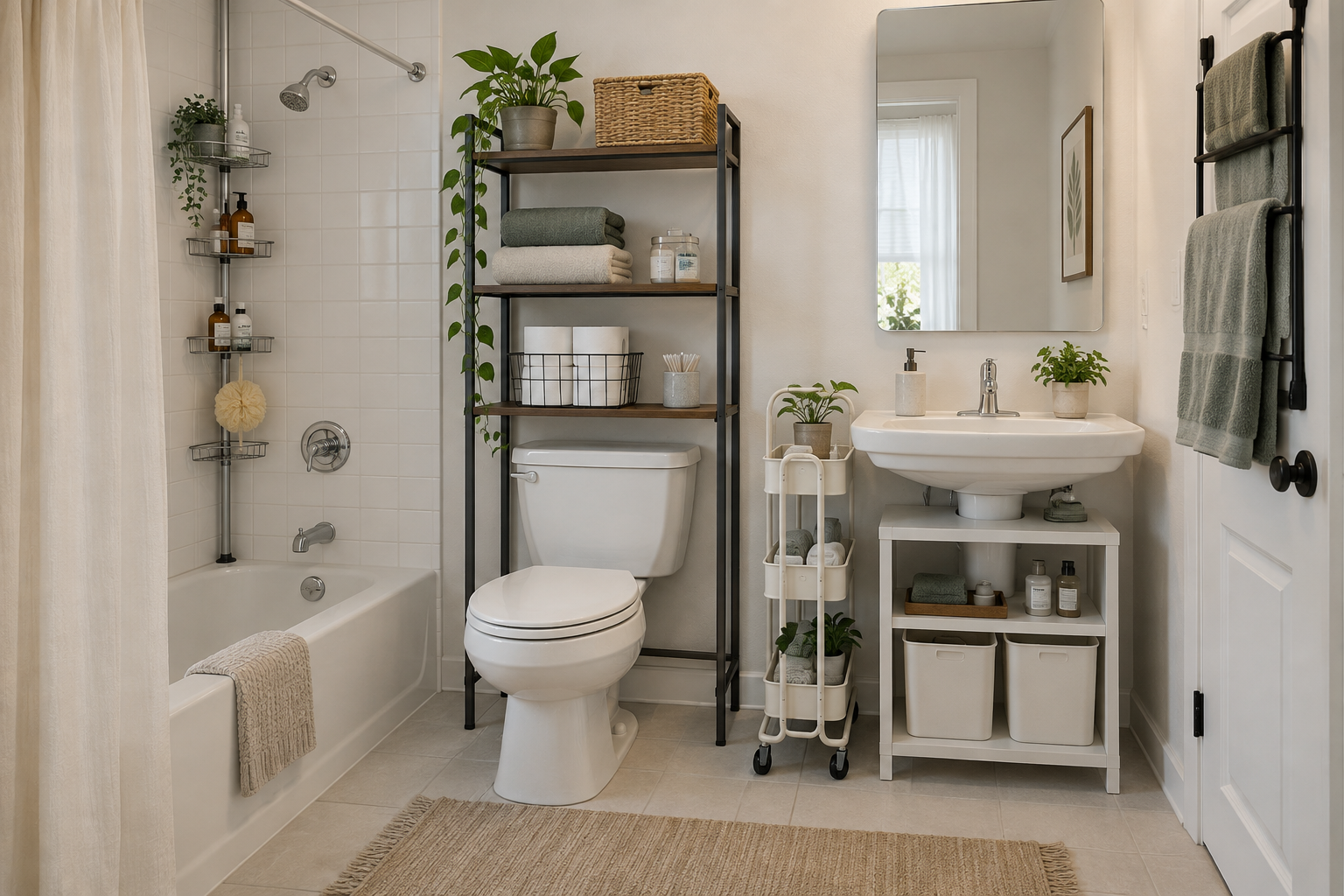
The wall above the toilet looks like wasted space, but it is also a bad place for weak adhesive shelves. Shampoo backups, glass jars, folded towels, and baskets become heavy quickly. For over toilet storage for renters, start with a freestanding solution instead of a mounted shelf.
A low, wide over-the-toilet shelf can work if it sits level, clears the tank lid, and does not interfere with the toilet handle. Measure three things before you buy: the toilet width, the distance from the floor to the top of the tank, and the depth from the wall to the front of the tank. Leave enough room to remove the tank lid for maintenance. If your toilet has a curved or unusually high tank, a simple rolling cart beside the toilet may be more practical than a bridge-style unit over it.
There is one important safety limit: tall freestanding bathroom furniture can create a furniture tip-over risk, especially where children live or visit. The U.S. Consumer Product Safety Commission advises anchoring furniture to help prevent tip-over incidents, but anchoring requires wall holes and landlord permission. In a no-drill rental bathroom, that means you should favor lower, heavier-bottomed pieces and avoid tall, narrow towers if a child could pull on them. The CPSC’s tip-over guidance is here: CPSC Anchor It statistics and recommendations.
If the toilet zone is cramped, use the tank itself for only the lightest daily items: a lidded tissue box, a small tray with room spray, or one extra roll of toilet paper. Avoid stacking open baskets of cosmetics or medicine there; tank lids are not shelves, and they are awkward to clean around.
Under the sink: work around the P-trap, not against it
An under sink bathroom organizer has to respect plumbing. The P-trap, supply lines, shutoff valves, and garbage-disposal-style obstructions in some vanities create dead zones that standard rectangular bins do not solve. Pull everything out first, clean the cabinet floor, and measure the usable rectangles on either side of the pipe.
A practical example: if the cabinet interior is 24 inches wide and the plumbing takes up the middle 8 inches, you may have two usable side zones of about 8 inches each, plus a shallow front strip. In that case, two narrow bins or drawers will work better than one wide organizer that hits the P-trap. If the cabinet is 18 inches deep but the pipe sits 10 inches back, choose a shorter front drawer and keep taller cleaning bottles in a side caddy.
Use categories rather than one large bin: daily hair tools, backup toiletries, cleaning supplies, and period products. Put leak-prone cleaners or extra shampoo in washable plastic bins, not fabric cubes. If your vanity has old particleboard flooring, add a removable waterproof tray under products that could drip. Keep access to shutoff valves clear; a perfect-looking cabinet is not worth delaying a plumbing fix.
For more small-space sorting principles outside the bathroom, the same edit-first logic appears in first apartment decorating on a budget: buy fewer specialized pieces until you know what the space actually needs.
Shower products: tension beats overloaded suction
Shower storage is where bathroom humidity, soap residue, and weight combine. A tension pole shower caddy is usually more reliable than several suction baskets if you have a flat tub ledge or shower corner and the ceiling height falls within the product’s stated range. Look for adjustable shelves so tall bottles can stand upright, and choose rust-resistant materials when possible.
A tension pole caddy still needs common-sense placement. It should not press against a fragile ceiling tile, sloped ceiling, loose tub surround, or cracked grout. Check that the pole is vertical after installation and that the heaviest bottles sit on lower shelves. If the caddy shifts when you remove a bottle, reduce the load rather than tightening it aggressively against surfaces that may not be sturdy.
Suction can be useful for a razor holder or a small soap dish on smooth tile or glass. It is less dependable for family-size bottles, textured tile, stone, painted wall surfaces, or any area with grout lines under the cup. Adhesive shower shelves are also surface- and product-specific; if you use them, reserve them for lighter items and follow the stated cure time before loading.
Keep only current shower products in the wet zone. Backups belong in a dry bin under the sink, in a hall closet, or on a rolling cart outside the spray path. Fewer bottles make cleaning easier, and cleaning is part of storage in a humid bathroom.
Towels: separate drying from storing
One common rental bathroom organization mistake is treating every hook as towel storage. A towel that is still damp needs airflow; a clean folded towel needs a dry place. Those are different jobs.
For the towel you use every day, an over-door bathroom storage rack with spaced hooks can work well if the door closes fully and the towels do not drag on the floor. A tension rod across an unused alcove or inside a tub opening can also provide drying space, as long as it does not interfere with shower curtains or ventilation. Adhesive bathroom hooks are better for hand towels, robes, or lightweight items than for several heavy wet bath towels.
For extra clean towels, use a lidded basket outside the wettest area, a narrow rolling cart, or a shelf in a nearby closet if your bathroom has poor ventilation. The EPA notes that moisture control is key to mold prevention and recommends using the bathroom fan or opening a window when showering; that advice matters for textiles as much as walls. You can read the EPA’s mold and moisture guidance here: EPA guide to mold, moisture, and your home.
If towels smell musty quickly, storage may not be the only problem. Run the fan longer, spread towels fully instead of layering them, and reduce the number of damp textiles kept in the room. A beautiful stack of towels beside the shower is not useful if the room never dries.
The door: useful, but check clearances first
The bathroom door is often the largest unused vertical surface in a small rental bathroom. Over door bathroom storage can hold towels, robes, a hanging organizer, or lightweight baskets for hair products. It is also fully removable, which makes it appealing for renters who do not want adhesive on paint.
Before buying an over-door rack, measure the door thickness and the gap above the door. Some older apartments have tight frames, layers of paint, or low-clearance trim that make thick metal brackets scrape. If the door will not close smoothly with the rack installed, do not force it; you may damage the frame or hinges. Felt pads on contact points can reduce rattling and scuffs, but they do not solve a rack that is too thick.
Use door storage for items that tolerate movement. Towels, robes, lightweight pouches, and a hair dryer in a secure basket are reasonable. Glass bottles, open cosmetics, and small loose items are less ideal because the door swings. If the only door is close to the toilet, choose closed pockets or baskets so items cannot fall into awkward places.
Pedestal sinks: add storage beside and around, not behind
Pedestal sink storage ideas have to account for the shape of the sink. A pedestal sink looks open, but the base and plumbing often block the exact spot where a cabinet would go. Instead of trying to hide everything under the basin, build storage in three zones: beside the pedestal, below the front curve, and on the nearest vertical surface.
A slim rolling cart is often the most flexible solution. Choose one that is shallow enough to clear the sink bowl and narrow enough to move for cleaning. Use the top tier for daily items in cups or small bins, the middle for folded washcloths or skincare, and the bottom for backup toilet paper or cleaning supplies in a washable container.
If there is floor room directly under the sink, a U-shaped shelf designed for pedestal sinks can hold light items, but it should not trap water around the base. Leave space to mop and check for leaks. Skirted sink storage can soften the look, but fabric near plumbing needs regular laundering and enough clearance from puddles or wet mops.
For the wall beside a pedestal sink, one or two bathroom-rated adhesive hooks may hold a hand towel or small toiletry pouch if the surface is compatible. If the wall is textured, flaking, freshly painted, or constantly damp, skip adhesive and use the cart instead. Renters working with temporary surfaces may also find the surface-safety mindset in renter-friendly wall decor ideas useful, though bathroom humidity adds stricter limits.
What not to store in a humid bathroom
Good small bathroom storage ideas for renters include knowing what to move out. Bathrooms are convenient, but heat, moisture, and light can damage certain items. MedlinePlus notes that heat, air, light, and moisture may damage medicines and that bathroom cabinets are a common but problematic place to store them. For medicine storage guidance, see MedlinePlus on storing medicines.
- Medicines and supplements: Store them according to label directions, often in a cooler, drier place away from children and pets.
- Bulk toilet paper: Keep only a few rolls in the bathroom if the room gets steamy; store the rest in a dry closet.
- Extra towels and linens: Move overflow to a linen closet, bedroom drawer, or sealed bin if ventilation is weak.
- Rarely used cosmetics: Heat and humidity can shorten usable life; keep daily items in the bathroom and backups elsewhere.
- Paper packaging: Cardboard boxes under the sink can absorb moisture and make leaks harder to spot.
A simple zone-by-zone plan
If you are starting from a messy rental bathroom, do not buy every organizer at once. Use this order so each purchase solves a real storage problem.
- Remove what does not belong in the bathroom. Move medicine, bulk paper goods, and extra linens to a drier location when possible.
- Assign daily-use zones. Put shower products in the shower, hand towel storage by the sink, and toilet paper within reach of the toilet.
- Measure before buying. Check toilet clearance, cabinet pipe locations, door thickness, and shower height.
- Choose the lowest-risk support method. Gravity and over-door pieces are usually easiest to remove; tension works well in the right dimensions; adhesive and suction are more surface-dependent.
- Load from heavy to light. Heavy backups go low in bins or carts; light daily items can go higher.
- Leave cleaning access. If an organizer prevents you from wiping tile, checking for leaks, or drying towels, it is creating a new bathroom problem.
The practical takeaway: in a rental bathroom, the best storage is not the most invisible storage. It is the method that matches the surface, moisture level, and weight of the item. Use freestanding or rolling storage for heavy goods, tension for showers where the structure allows it, over-door racks for towels and soft goods, and bathroom-rated adhesive only for light items on compatible smooth surfaces. That combination gives a small bathroom more function without turning move-out day into a repair project.